
28 eggs at true relative size, from the 30 mm egg of the Northern Bobwhite to the 69 mm egg of the Indian Peafowl.
About this collection. These eggs cover most of the birds that nest in Canada and the United States, plus a few famous eggs from elsewhere, like the Ostrich and the extinct Elephant Bird. It isn’t every bird in the world yet; we’ll update this note as the collection grows.


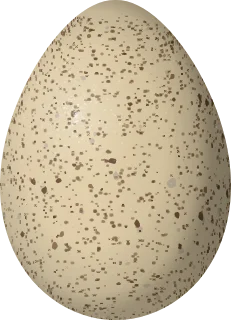


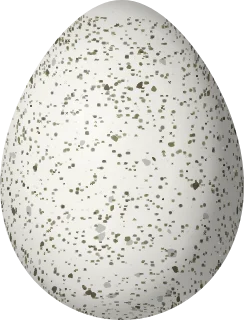


California Quail
Callipepla californica
- 32 × 25 mm
- Clutch: 12–16 eggs
White to creamy with variable brown markings.
Sources of information
- Size
- Average of 60 eggs: Bent, Life Histories of North American Gallinaceous Birds (U.S. National Museum Bulletin 162, 1932), p. 60.
- Description
- Cornell Lab of Ornithology, All About Birds: California Quail, Life History.
- Clutch
- Cornell Lab of Ornithology, All About Birds.
- Shape
- Drawn from the length and width, with the taper estimated from the typical eggs of its group (how these eggs are drawn).
Make a 3D-printable copy of this egg →See posters with this egg →
Chukar
Alectoris chukar
- 43 × 31.4 mm
- Clutch: 10–21 eggs
Pale white to coffee colored, with purplish, reddish, or yellowish brown spots.
Sources of information
- Size
- Average of 250 eggs: Baker, The Nidification of Birds of the Indian Empire, Vol. 4 (1935) (250 eggs).
Agrees with: Cornell Lab of Ornithology, All About Birds: Chukar, Life History. - Description
- Cornell Lab of Ornithology, All About Birds: Chukar, Life History.
- Clutch
- Cornell Lab of Ornithology, All About Birds.
- Shape
- Drawn from the length and width, with the taper estimated from the typical eggs of its group (how these eggs are drawn).
Coturnix Quail
Coturnix japonica
- 35 × 27 mm
Cream to buff, heavily blotched with dark brown and black.
Sources of information
- Size
- Brinsea: Egg Sizes (incubator maker’s egg measurement table).
- Description
- Wikipedia: Japanese quail.
- Shape
- Drawn from the length and width, with the taper estimated from the typical eggs of its group (how these eggs are drawn).
Make a 3D-printable copy of this egg →See posters with this egg →
Domestic Chicken
Gallus gallus domesticus
- 58 × 40 mm
Light brown.
Sources of information
- Size
- SaviMade's original preset (a typical egg).
Agrees with: Brinsea: Egg Sizes (the same size as their bantam hen egg). - Description
- SaviMade's description of a typical egg.
- Shape
- Drawn from the length and width, with the taper estimated from the typical eggs of its group (how these eggs are drawn).
Make a 3D-printable copy of this egg →See posters with this egg →
Dusky Grouse
Dendragapus obscurus
- 49.7 × 34.9 mm
- Clutch: 1–12 eggs
Pale buff, finely speckled with brown.
Sources of information
- Size
- Average of 54 eggs: Bent, Life Histories of North American Gallinaceous Birds (U.S. National Museum Bulletin 162, 1932), p. 92.
Agrees with: Cornell Lab of Ornithology, All About Birds: Dusky Grouse, Life History. - Description
- Bent, Life Histories of North American Gallinaceous Birds (U.S. National Museum Bulletin 162, 1932), p. 92.
- Shape
- Drawn from the length and width, with the taper estimated from the typical eggs of its group (how these eggs are drawn).
Make a 3D-printable copy of this egg →See posters with this egg →
Gambel's Quail
Callipepla gambelii
- 31.5 × 24 mm
- Clutch: 5–15 eggs
Dull white to buff with irregular, cinnamon-brown splotches.
Sources of information
- Size
- Average of 99 eggs: Bent, Life Histories of North American Gallinaceous Birds (U.S. National Museum Bulletin 162, 1932), p. 78.
Agrees with: Cornell Lab of Ornithology, All About Birds: Gambel's Quail, Life History. - Description
- Cornell Lab of Ornithology, All About Birds: Gambel's Quail, Life History.
- Clutch
- Cornell Lab of Ornithology, All About Birds.
- Shape
- Drawn from the length and width, with the taper estimated from the typical eggs of its group (how these eggs are drawn).
Gray Partridge
Perdix perdix
- 36.8 × 27.4 mm
- Clutch: 10–22 eggs
Unmarked buff, brown, or olive.
Sources of information
- Size
- Average of 100 eggs: Bent, Life Histories of North American Gallinaceous Birds (U.S. National Museum Bulletin 162, 1932), p. 4.
Agrees with: Cornell Lab of Ornithology, All About Birds: Gray Partridge, Life History. - Description
- Cornell Lab of Ornithology, All About Birds: Gray Partridge, Life History.
- Clutch
- Cornell Lab of Ornithology, All About Birds.
- Shape
- Drawn from the length and width, with the taper estimated from the typical eggs of its group (how these eggs are drawn).
Make a 3D-printable copy of this egg →See posters with this egg →
Greater Prairie-Chicken
Tympanuchus cupido
- 44.86 × 33.59 mm
- Clutch: 5–17 eggs
Olive-buff, finely speckled with brown.
Sources of information
- Size
- Average of 100 eggs: Bent, Life Histories of North American Gallinaceous Birds (U.S. National Museum Bulletin 162, 1932), p. 247.
- Description
- Bent, Life Histories of North American Gallinaceous Birds (U.S. National Museum Bulletin 162, 1932), p. 247.
- Shape
- Drawn from the length and width, with the taper estimated from the typical eggs of its group (how these eggs are drawn).
Greater Sage-Grouse
Centrocercus urophasianus
- 56.5 × 38.5 mm
- Clutch: 4–11 eggs
Variable shades of olive-buff or pale greenish, with fine, darker markings.
Sources of information
- Size
- Cornell Lab of Ornithology, All About Birds: Greater Sage-Grouse, Life History.
- Description
- Cornell Lab of Ornithology, All About Birds: Greater Sage-Grouse, Life History.
- Clutch
- Cornell Lab of Ornithology, All About Birds.
- Shape
- Drawn from the length and width, with the taper estimated from the typical eggs of its group (how these eggs are drawn).
Make a 3D-printable copy of this egg →See posters with this egg →
Gunnison Sage-Grouse
Centrocercus minimus
- 55 × 38 mm (approx.)
- Clutch: 3–10 eggs
Variable shades of olive-buff to pale greenish, with fine, darker markings.
Sources of information
- Size
- Cornell Lab of Ornithology, All About Birds: Gunnison Sage-Grouse, Life History.
- Description
- Cornell Lab of Ornithology, All About Birds: Gunnison Sage-Grouse, Life History.
- Clutch
- Cornell Lab of Ornithology, All About Birds.
- Shape
- Drawn from the length and width, with the taper estimated from the typical eggs of its group (how these eggs are drawn).
Helmeted Guineafowl
Numida meleagris
- 53 × 40 mm
Buff, finely speckled with brown.
Sources of information
- Size
- New Zealand Birds Online: Helmeted guineafowl.
- Description
- New Zealand Birds Online: Helmeted guineafowl.
- Shape
- Drawn from the length and width, with the taper estimated from the typical eggs of its group (how these eggs are drawn).
Make a 3D-printable copy of this egg →See posters with this egg →
Himalayan Snowcock
Tetraogallus himalayensis
- 65.4 × 45.4 mm
Pale olive-buff, spotted with reddish brown.
Sources of information
- Size
- Average of 68 eggs: Baker, The Nidification of Birds of the Indian Empire, Vol. 4 (1935) (68 eggs).
- Description
- Baker, The Nidification of Birds of the Indian Empire, Vol. 4 (1935).
- Shape
- Drawn from the length and width, with the taper estimated from the typical eggs of its group (how these eggs are drawn).
Indian Peafowl
Pavo cristatus
- 69 × 46 mm
- Clutch: 4–10 eggs
Buff to cream, unmarked.
Sources of information
- Size
- Wikipedia: Indian peafowl.
- Description
- Wikipedia: Indian peafowl.
- Shape
- Drawn from the length and width, with the taper estimated from the typical eggs of its group (how these eggs are drawn).
Make a 3D-printable copy of this egg →See posters with this egg →
Lesser Prairie-Chicken
Tympanuchus pallidicinctus
- 41.9 × 32 mm
Whitish to ivory yellow, speckled with pale brown, lavender, or olive.
Sources of information
- Size
- Average of 47 eggs: Bent, Life Histories of North American Gallinaceous Birds (U.S. National Museum Bulletin 162, 1932), p. 282.
- Description
- Cornell Lab of Ornithology, All About Birds: Lesser Prairie-Chicken, Life History.
- Shape
- Drawn from the length and width, with the taper estimated from the typical eggs of its group (how these eggs are drawn).
Montezuma Quail
Cyrtonyx montezumae
- 31.9 × 24.7 mm
- Clutch: 2–15 eggs
White to creamy white.
Sources of information
- Size
- Average of 39 eggs: Bent, Life Histories of North American Gallinaceous Birds (U.S. National Museum Bulletin 162, 1932), p. 86.
- Description
- Cornell Lab of Ornithology, All About Birds: Montezuma Quail, Life History.
- Clutch
- Cornell Lab of Ornithology, All About Birds.
- Shape
- Drawn from the length and width, with the taper estimated from the typical eggs of its group (how these eggs are drawn).
Mountain Quail
Oreortyx pictus
- 34.1 × 26.7 mm
- Clutch: 9–15 eggs
Creamy, buffy, or pinkish, without speckles.
Sources of information
- Size
- Average of 61 eggs: Bent, Life Histories of North American Gallinaceous Birds (U.S. National Museum Bulletin 162, 1932), p. 42.
Agrees with: Cornell Lab of Ornithology, All About Birds: Mountain Quail, Life History. - Description
- Cornell Lab of Ornithology, All About Birds: Mountain Quail, Life History.
- Clutch
- Cornell Lab of Ornithology, All About Birds.
- Shape
- Drawn from the length and width, with the taper estimated from the typical eggs of its group (how these eggs are drawn).
Northern Bobwhite
Colinus virginianus
- 30 × 24 mm
- Clutch: 7–28 eggs
Dull or creamy white.
Sources of information
- Size
- Average of 55 eggs: Bent, Life Histories of North American Gallinaceous Birds (U.S. National Museum Bulletin 162, 1932), p. 14.
- Description
- Cornell Lab of Ornithology, All About Birds: Northern Bobwhite, Life History.
- Clutch
- Cornell Lab of Ornithology, All About Birds.
- Shape
- Drawn from the length and width, with the taper estimated from the typical eggs of its group (how these eggs are drawn).
Make a 3D-printable copy of this egg →See posters with this egg →
Plain Chachalaca
Ortalis vetula
- 58.4 × 40.9 mm
- Clutch: 2–4 eggs
Buffy white.
Sources of information
- Size
- Average of 56 eggs: Bent, Life Histories of North American Gallinaceous Birds (U.S. National Museum Bulletin 162, 1932), p. 348.
- Description
- Cornell Lab of Ornithology, All About Birds: Plain Chachalaca, Life History.
- Clutch
- Cornell Lab of Ornithology, All About Birds.
- Shape
- Drawn from the length and width, with the taper estimated from the typical eggs of its group (how these eggs are drawn).
Ring-necked Pheasant
Phasianus colchicus
- 45 × 35.5 mm
- Clutch: 7–15 eggs
Olive-brown to blue-gray.
Sources of information
- Size
- Cornell Lab of Ornithology, All About Birds: Ring-necked Pheasant, Life History.
- Description
- Cornell Lab of Ornithology, All About Birds: Ring-necked Pheasant, Life History.
- Clutch
- Cornell Lab of Ornithology, All About Birds.
- Shape
- Drawn from the length and width, with the taper estimated from the typical eggs of its group (how these eggs are drawn).
Make a 3D-printable copy of this egg →See posters with this egg →
Rock Ptarmigan
Lagopus muta
- 42 × 30 mm
- Clutch: 3–13 eggs
Pale buff with brown spots.
Sources of information
- Size
- Average of 99 eggs: Bent, Life Histories of North American Gallinaceous Birds (U.S. National Museum Bulletin 162, 1932), p. 206.
- Description
- Cornell Lab of Ornithology, All About Birds: Rock Ptarmigan, Life History.
- Clutch
- Cornell Lab of Ornithology, All About Birds.
- Shape
- Drawn from the length and width, with the taper estimated from the typical eggs of its group (how these eggs are drawn).
Make a 3D-printable copy of this egg →See posters with this egg →
Ruffed Grouse
Bonasa umbellus
- 39.6 × 29.5 mm
- Clutch: 9–14 eggs
Milky to cinnamon buff sometimes spotted with reddish or brown.
Sources of information
- Size
- Cornell Lab of Ornithology, All About Birds: Ruffed Grouse, Life History.
- Description
- Cornell Lab of Ornithology, All About Birds: Ruffed Grouse, Life History.
- Clutch
- Cornell Lab of Ornithology, All About Birds.
- Shape
- Drawn from the length and width, with the taper estimated from the typical eggs of its group (how these eggs are drawn).
Make a 3D-printable copy of this egg →See posters with this egg →
Scaled Quail
Callipepla squamata
- 32.6 × 25.2 mm
- Clutch: 7–14 eggs
Creamy, speckled with light brown.
Sources of information
- Size
- Average of 57 eggs: Bent, Life Histories of North American Gallinaceous Birds (U.S. National Museum Bulletin 162, 1932), p. 53.
- Description
- Cornell Lab of Ornithology, All About Birds: Scaled Quail, Life History.
- Clutch
- Cornell Lab of Ornithology, All About Birds.
- Shape
- Drawn from the length and width, with the taper estimated from the typical eggs of its group (how these eggs are drawn).
Sharp-tailed Grouse
Tympanuchus phasianellus
- 42.6 × 32 mm
- Clutch: 9–12 eggs
Light brown to olive-buff, finely speckled with dark brown.
Sources of information
- Size
- Average of 58 eggs: Bent, Life Histories of North American Gallinaceous Birds (U.S. National Museum Bulletin 162, 1932), p. 294.
Agrees with: Cornell Lab of Ornithology, All About Birds: Sharp-tailed Grouse, Life History. - Description
- Bent, Life Histories of North American Gallinaceous Birds (U.S. National Museum Bulletin 162, 1932), p. 294.
- Shape
- Drawn from the length and width, with the taper estimated from the typical eggs of its group (how these eggs are drawn).
Make a 3D-printable copy of this egg →See posters with this egg →
Sooty Grouse
Dendragapus fuliginosus
- 48.5 × 35 mm
Pale buff, speckled with brown.
Sources of information
- Size
- Average of 92 eggs: Bent, Life Histories of North American Gallinaceous Birds (U.S. National Museum Bulletin 162, 1932), p. 107.
- Description
- Cornell Lab of Ornithology, All About Birds: Sooty Grouse, Life History.
- Shape
- Drawn from the length and width, with the taper estimated from the typical eggs of its group (how these eggs are drawn).
Spruce Grouse
Canachites canadensis
- 43.2 × 31.1 mm
- Clutch: 4–9 eggs
Olive with variable spots.
Sources of information
- Size
- Average of 53 eggs: Bent, Life Histories of North American Gallinaceous Birds (U.S. National Museum Bulletin 162, 1932), p. 133.
- Description
- Cornell Lab of Ornithology, All About Birds: Spruce Grouse, Life History.
- Clutch
- Cornell Lab of Ornithology, All About Birds.
- Shape
- Drawn from the length and width, with the taper estimated from the typical eggs of its group (how these eggs are drawn).
Make a 3D-printable copy of this egg →See posters with this egg →
White-tailed Ptarmigan
Lagopus leucura
- 42.9 × 29.5 mm
- Clutch: 2–8 eggs
Light cinnamon, showing dark spots toward the time of hatching.
Sources of information
- Size
- Average of 31 eggs: Bent, Life Histories of North American Gallinaceous Birds (U.S. National Museum Bulletin 162, 1932), p. 236.
- Description
- Cornell Lab of Ornithology, All About Birds: White-tailed Ptarmigan, Life History.
- Clutch
- Cornell Lab of Ornithology, All About Birds.
- Shape
- Drawn from the length and width, with the taper estimated from the typical eggs of its group (how these eggs are drawn).
Make a 3D-printable copy of this egg →See posters with this egg →
Wild Turkey
Meleagris gallopavo
- 62.6 × 44.6 mm
- Clutch: 4–17 eggs
Pale yellowish tan, evenly marked with reddish brown or pinkish spots.
Sources of information
- Size
- Average of 56 eggs: Bent, Life Histories of North American Gallinaceous Birds (U.S. National Museum Bulletin 162, 1932), p. 332.
Agrees with: Cornell Lab of Ornithology, All About Birds: Wild Turkey, Life History. - Description
- Cornell Lab of Ornithology, All About Birds: Wild Turkey, Life History.
- Clutch
- Cornell Lab of Ornithology, All About Birds.
- Shape
- Drawn from the length and width, with the taper estimated from the typical eggs of its group (how these eggs are drawn).
Make a 3D-printable copy of this egg →See posters with this egg →
Willow Ptarmigan
Lagopus lagopus
- 43 × 31 mm
- Clutch: 4–14 eggs
Yellowish to reddish buff, heavily blotched and spotted with dark reddish brown to black.
Sources of information
- Size
- Average of 250 eggs: Bent, Life Histories of North American Gallinaceous Birds (U.S. National Museum Bulletin 162, 1932), p. 182.
Agrees with: Cornell Lab of Ornithology, All About Birds: Willow Ptarmigan, Life History. - Description
- Bent, Life Histories of North American Gallinaceous Birds (U.S. National Museum Bulletin 162, 1932), p. 182.
- Shape
- Drawn from the length and width, with the taper estimated from the typical eggs of its group (how these eggs are drawn).
Make a 3D-printable copy of this egg →See posters with this egg →